Friday, April 29, 2011

Friday Favorites: Firsts

I find myself reading series more often than not - but almost every time, it's the first book of the series that I end up loving most:


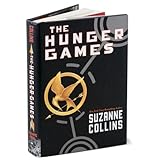
THE HUNGER GAMES


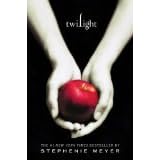
TWILIGHT
(Yeah, I liked TWILIGHT. I'm a Cullen wannabe. And I thought it ended perfectly.)


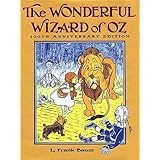
THE WIZARD OF OZ
(Yes, there were more. Lots, lots more. You should read them.)

Why is that?

And what about you? Are there any good series out there that have awesome second and third and onward books? Is the first one ALWAYS the best?

Wednesday, April 27, 2011

Wisdom on Wednesdays: Being Generous

In the acting world, I used to hear this phrase all the time: "He/she's such a generous actor."

And I'd think a lot about what that means.

It means not hogging the spotlight.

It means thinking about the scene first, and putting aside your ideas about how things should go to find what works.

It means saying "yes" to your colleagues' ideas, and giving them ideas that they can say "yes" to.

It means being a team player.

It's the same in writing:

There are lots of books in the sea; yours is just one of them. This is a good thing.

Sometimes, we have to kill our darlings to make the story work.

Sometimes, we have to let the characters take us where they want to go.

Sometimes, writers need to lean on each other. We ask for support when we need it, and we support others when they need it.

It's a happy coincidence that my friend Matthew is doing a critique of a picture book query today on his blog, and he asked me to go over there and see if I could lend a few ideas. Without even knowing it, he was giving me an opportunity to be generous. If any of you write picture books, I invite you to go over there and do the same.

And when you write today, write with generosity in your hearts and at your fingertips.

Monday, April 25, 2011

Writing Craft: Details, Details

The perfect scene is the scene that gives you just the right one or two details that you need to get a sense of the whole thing: the atmosphere, the setting, and what the characters are thinking or feeling, both in that moment as you enter the scene and throughout the scene as you take them (and their changing emotions) through it.

So, how the heck do you do that?

One way that works for me, since I watch a lot of movies (and, let's face it, I'm addicted to my favorite TV shows - I even get all snappy and irritable on rerun weeks, and I get all giddy when a new episode is coming up, and OMG SUMMER IS COMING SOON AND WHAT AM I GOING TO DOOOOOO??? *ahem* It might be a little unhealthy.), is to think of the scene as if it were being played out on-screen.

You know how often new scenes start with a close-up of something? Someone's hands fidgeting with the hem of their skirt, or a vase of half-wilted flowers on the side table, or something? Well, those are the same details you can start your scene with. Of course, it's probably not a good idea to start with those examples, because they're clichès, but you should think carefully about the tone you want to set, because the details you start with will dictate how your reader approaches each scene. Choose the one or two details that you would zoom in on if you were the director and this were your show.

And as I move through the scene, I picture it in my mind, and I write the details that my mental camera zooms in on. If the protagonist is feeling cornered by an intruder and needs to get away, in my mind, the camera zooms in on her grabbing the vase of half-wilted flowers and tracks the vase her as she hurls it at him. So, that's the detail I focus on; not what her body is doing, or what he's doing to dodge it, but her hands on the vase of flowers. (Again, clichè, but you know what I mean, right?)

So, that's how I approach it. How about you? Do you write with your zoom lens attached, or do you have another method? What works for you?

Friday, April 22, 2011

Friday Favorites: Trees and Books

I love trees. I love the shade they provide on the hottest days of summer; I love look of their skeletons in winter, covered in a thin layer of snow, or dipped in glittering ice; I love the smell of their leaves unfurling in the spring, and the feeling of their rough bark beneath my hands; I love the way they shape the skyline; I love the contrast of their leaves against the cloudless sky, deep earthy green and endless blue.

I love books, the paper ones. I love the smell of them; I love the way they look on my bookcase, spines all lined up, an ever-shifting pattern of colors and textures; I love holding them, leafing through their pages, finding that perfect passage that has been read so many times that the binding is strained there; I love browsing through the shelves of undisclosed riches in the library and the bookstore; I love the feeling of my arms straining to bear the weight of my newfound treasures.

Today is a day when I experience the conflict of loving these two things.

Today is Earth Day.

Plant something.

Lend a book.

Wednesday, April 20, 2011

Publishing Is Not About Books

Rachelle Gardner recently wrote this interesting post about the publishing industry and the music industry, and how much they (don't) have in common. It got me thinking, and what it got me thinking was this:

We've got it all wrong.


We've been talking about the future of publishing with the advent of the e-reader, and what will happen to publishing, and how self-pubbed e-books will change publishing, and and and. But here's the thing:

Publishing is not about books.


Publishing is about storytelling.


It's not about the words on the page (or the e-ink on the screen). Publishers create audiobooks, which in my mind are analogous to CDs. And more and more people are opting to listen to the audiobook instead of reading the words on the page - and hey, since you can do that AND clean your house at the same time, you can hardly argue.

And let's not forget about film rights: more and more books are optioned for film these days. Going to the movies is, for many, many, many people, an alternative to reading a book. For one thing, it's a hell of a lot quicker. And I think that in our time-pressured society, in which people are trying to cram more and more into our already-packed schedules (full-time job, family, pet, home repairs, and writing on the side, anyone?), the number of people investing in audiobooks and opting to skip the book in favor of the movie is only going to go up.

Books? I love them. I am a true bibliophile. I want a 3,600-sq-ft library like Jay Walker's. But mark my words: they're going to go the way of sheet music and movie scripts.

Publishing? It will survive. But not as we know it.

What do you think? Do you agree? Disagree? 

Tuesday, April 19, 2011

Writing Craft: Picture Books and the Rule of Three

First, I have family in town. Woo-Hoo! And also, Oh, Man! Because this means things just might get a little off-schedule here at the blog as I cram the additional obligation of socialising with my houseguest into my already overcrowded schedule.

So, since we're short on time, let's get down to business. Most of you have probably already heard about the Rule of Three, but when I started writing PBs, I hadn't. I just put it in my manuscript: the main character tried to solve her problem three times before she finally got it right. I didn't mean anything by it; it's just that two didn't feel like enough, and four felt like dragging it on a bit. And then I posted it on the SCBWI boards, and a critiquer said, "You did a nice job incorporating the Rule of Three in there."

And I went, "Wha-huh?" And I thanked her, modestly, because no-one likes a braggart, even when it's obvious that the braggart is a genius. And then I went and looked it up. :-) And I went, "OHHHH!" And I realised I'm not such a genius after all.

Basically, the Rule of Three is this: when writing a PB, do things as much as possible in threes. If a character has a defining characteristic, give three examples. If the character is solving a problem, make them try and fail three times. Jane O'Connor's FANCY NANCY starts off with a great example of this when Nancy says she likes being fancy, then lays out what that means for her by listing three fancy things that she does.


Another great example is Julia Donaldson's The Gruffalo, in which a mouse is first threatened by three different animals, then goes back and scares the same three animals. 


And it's kind of a no-brainer, because when you think about it, things are in threes everywhere: three acts in a play, three movements in a symphony, triangles in classical art, three, three, three. Even bad things, as the saying goes, happen in threes. Cerberus had three heads. Humans like the number three, and it's ingrained in us. So go with it.

Everybody repeat after me: THREE is a magic number...

Hee-hee. Happy Monday night!

Can you think of examples, either PBs or novels, that do things in threes? Share with us.
Friday, April 15, 2011

Friday Favorites: DYSTOPIAS

I love a good dystopian novel. I mean, LOVE. Dystopian is, by far, my favorite genre. These books make me think hard about where society is headed, and about whether I like it or want to go a different way. They make me think about who I am, and what I stand for. They help me to define myself. And, perhaps strangely, I find them to be rather affirming. (I might have some issues with questioning authority and some control-freak tendencies going on there. Just maybe.)

So, let's talk good dystopians! Some of my faves are:

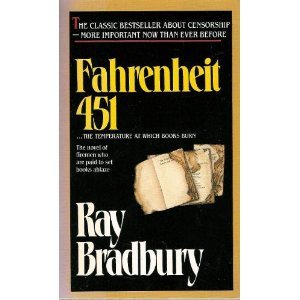
FAHRENHEIT 451, by Ray Bradbury. This is one of the classics, guys. If you used the Cliff's Notes when you were supposed to read this in High School, then shame on you. This is a world where real thinking is shunned in favor of mindless pap, and where reading as an intellectual pursuit is illegal. As an aside, the TODAY show this morning featured stories about how and why men are pursuing more and more plastic surgery, and the phenomenon of "WombTubing," in which women video-document their pregnancies (from the first reading of the pregnancy test onwards) and post the vids on YouTube, Facebook, and Twitter. I don't really need to say any more than that, do I? Go read this book. And if you've already read it, re-read it.

1984, by George Orwell (who also wrote ANIMAL FARM, another of my favorites). TV is ubiquitous, the government is totalitarian, and everybody tries to be the same as everybody else. The only part I don't recognize as I look around me now is the totalitarian government part. This book is possibly the most prescient piece of literature ever created, with the exception of:

FEED, by MT Anderson. I would give both my legs and a kidney to be able to write like this. And did I mention that even I am on Twitter? And when I'm not online, I wonder what information I'm missing out on? Look out, guys: The Feed is coming.

There are more, of course, but these are the ones I'd take with me to a deserted island if I could. (Which makes it sound like I would WANT to go to a deserted island... Which, come to think of it, I might. Peace and quiet and sunshine and ocean, anyone?)

How about you? What are your favorite dystopians? And if you hate the genre, what is your favorite genre?